Blackberry Defect Classification Guidelines
Contents
CAPS / CALYXES
Berries that still have the “cap” or calyx attached shall be considered as Damage.
DEFORMED DRUPLETS
“Well developed” is a requirement of the U.S. No. 1 grade for raspberries and blackberries. Berries that are misshapen, deformed, or have not attained a normal shape and development due to frost injury, lack of pollination, insect injury, or other causes shall not meet the requirements of well developed. Blackberries have a tendency to exhibit “deformed drupelets, mainly due to poor pollinations.
Damage: > 1/4 of the drupelets are dry or deformed
Serious Damage > 1/2 of the drupelets are dry or deformed.
INSECT DAMAGE / PRESENCE OF LIVE INSECTS
(a) No insects present, but minor, superficial external feeding injury noted, or (b) Any feeding injury that materially detracts from appearance.
(a) External insect feeding damage affecting > 1/4-inch circle (agg.), or
(b) More than 1 live or 3 dead insects are present, or
(c) Presence of excreta or frass is noted, or
(d) Any feeding injury that seriously detracts from appearance.
OVERRIPE, SOFT, SPLIT, CRUSHED, and/or LEAKING BERRIES. While any of these defects can cause berries to leak their juice and deteriorate rapidly, overripe or soft berries are dead ripe or mushy, necessitating immediate consumption. Such berries are generally dark red, have a dull appearance, and are watery. Overripe, Soft, Split, Crushed, or Leaking berries are always scored as Serious Damage.
A good indicator of overripe, leaking berries is stains found on the pads at the bottom of each clamshell.
NOTE:
Do not confuse wet berries caused by leaking juices with condensation, which is not a defect.
RED CELL / POORLY COLORED (Blackberries only)
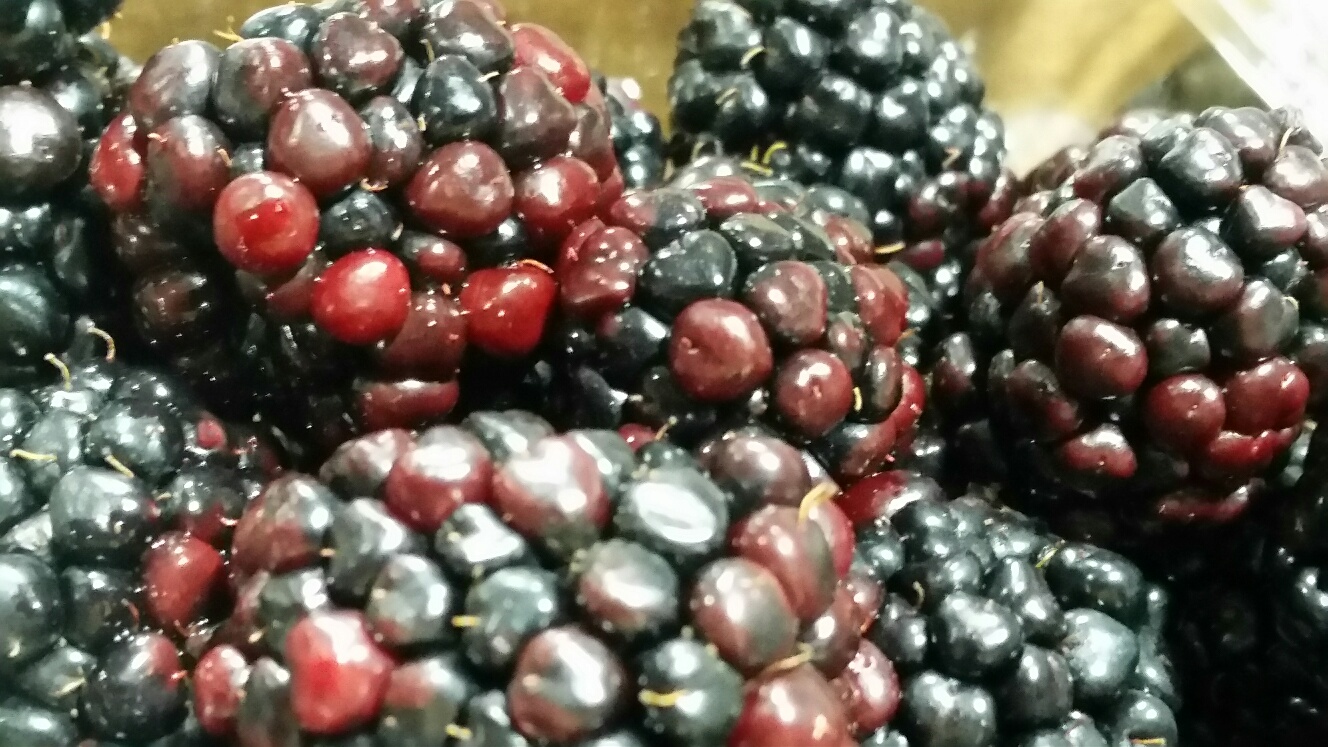
The U.S. Standards for Blackberries states that they must be “well colored”, which is defined as 100 percent of the berry’s surface must be a blue to black color. However, most Blackberry lots are found to contain berries with drupelets that are red to maroon in color. This defect is commonly referred to as “Red Cell.” As the berry industry has to allow for some of these “off” colors lest every load of Blackberries could face rejection, score Red Cell as follows:
> 10% of berry surface is red, maroon, or some shade of red color.
> 25% of the berry surface is red, maroon, or some shade of red color..
SUNSCALD
Sunscald is caused by high temperatures and over-exposure to the sun. Symptoms appear on the upper side of fruit, near the calyx, just before ripening. The fruit becomes pale and mushy at first, eventually drying down to a distinct, firm, bleached lesion ranging in color from pink to off-grey. Sunscald is a “free from” defect and is always scored as Serious Damage.
DECAY AND MOLD.
There are several different types of decay that affect berries. Some form a “fuzzy” nest while others are firm and no mold growth is present. All are scored against the Decay tolerance.
OTHER DEFECTS
Other defects not included above that materially detract from appearance scored as Damage. If the defects seriously detract from appearance, then they are scored as Serious Damage.